
What it is
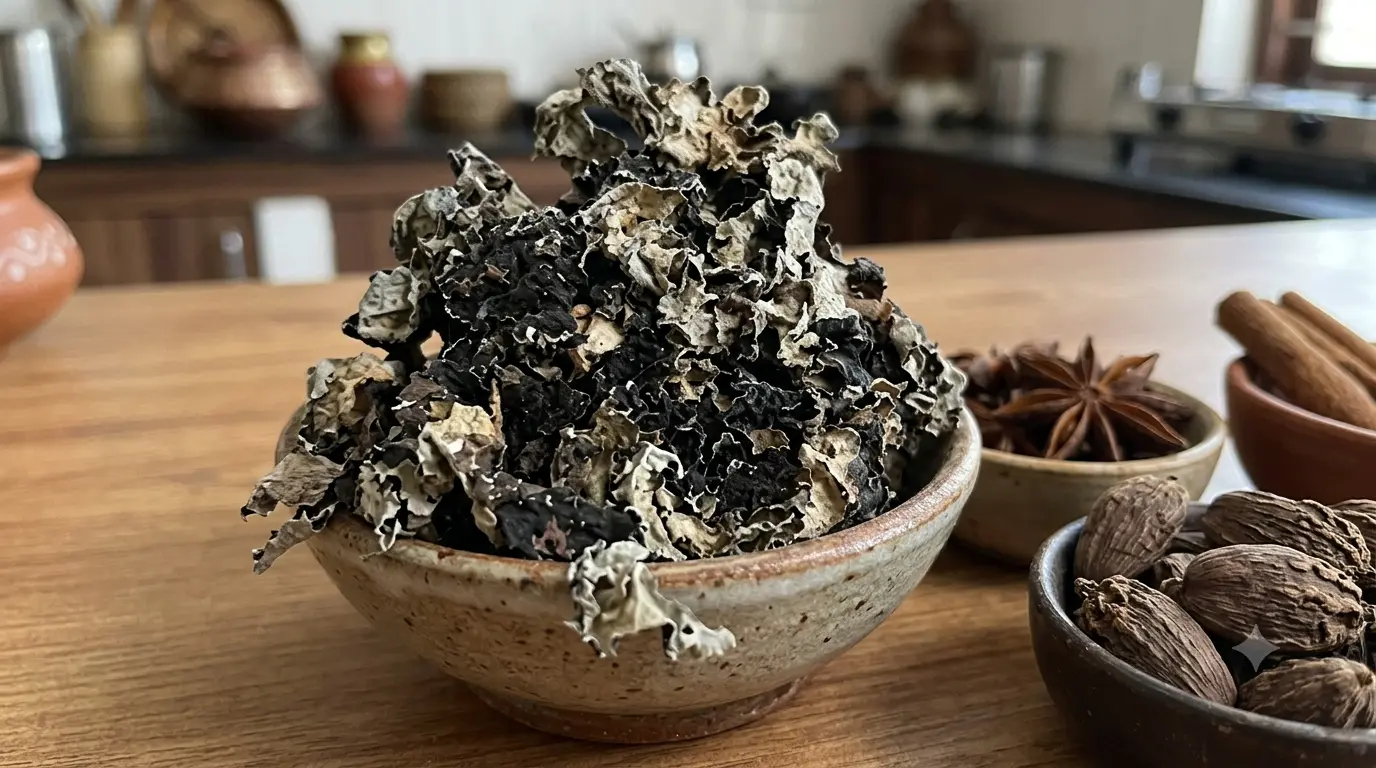
This is Patthar phool, the stone flower you use as a quiet background spice. It’s an edible foliose lichen from the genus Parmotrema, chiefly Parmotrema perlatum, in the family Parmeliaceae.
Harvested from rocks and tree barks, it’s sold in whole, well-dried clusters. Around India you’ll also hear Dagad phool (Marathi), Kalpasi (Tamil), Kallu hoovu (Kannada), Rathi poovu (Telugu), and Shaileya (Sanskrit).
Flavour and aroma
Raw Patthar phool has virtually no aroma or taste. Once it hits hot oil or ghee, it turns woody, earthy and mildly smoky with a delicate, forest-like aroma. In gravies and stews it lends a deep savory, umami background.
Cooking with it
When to add it
Add it early in the tadka so the fat carries its aroma, or simmer it in a potli or with wet pastes during cooking to build quiet depth. It boosts savory notes in vegetarian and meat stews.
It is an indispensable part of Chettinad masala for classic non-vegetarian curries. It’s essential in Maharashtrian Goda masala and Kala masala, and features in Awadhi potli masala for slow-simmered dishes such as nihari and galauti kebabs.
Origin and where it grows
Stone flower is native to high-altitude temperate and subtropical forests across the Himalayas and the montane regions of peninsular India. Key wild collection zones include Tamil Nadu’s Nilgiri and Palani hills, Kerala’s moist evergreen forests, Maharashtra’s Western Ghats, and the hill ranges of Karnataka.
Grown in
Buying and storing
How to pick good quality
Choose intact, lightweight, papery clusters that display a pale grey to dark charcoal-mottled upper surface and a darker undersurface, avoiding packets with excessive crumble or dust.
Simple adulteration check
Because it is wild-foraged from rocks and trees, inspect and manually clean batches before cooking to remove embedded bark flakes, soil particles, and grit.
Storage
Keep dried stone flower in an airtight glass or food-grade tin container placed in a cool, dry pantry away from humid kitchen steam.
Shelf life: Roughly one year.
Frequently asked questions
What is stone flower (Patthar phool)?
An edible foliose lichen in the genus Parmotrema, chiefly Parmotrema perlatum. It’s sold whole and dried and used as a spice.
When should I add it while cooking?
Add it at the tadka stage in hot oil or ghee so its fat-soluble aromatics infuse the base. You can also simmer it in a potli or with wet pastes during cooking.
What does it taste or smell like?
Raw it’s almost blank; once fried gently it becomes earthy, woody, mildly smoky and aromatic, adding a deep savory, umami note.
Which dishes or masalas use it in India?
Chettinad masala for classic non-vegetarian curries, Maharashtrian Goda and Kala masala, and Awadhi potli masala for nihari and galauti kebabs.
How do I pick and clean good Patthar phool?
Choose intact, lightweight, papery clusters with pale grey to dark charcoal-mottled tops and a darker underside, avoiding excess crumble or dust. Before cooking, inspect and manually clean to remove bark, soil and grit.
Related ingredients
 Spice
SpiceBlack cardamom
बड़ी इलायची (Badi elaichi)
 Spice
SpiceBlack salt
काला नमक (Kala namak)
 Spice
SpiceCumin seeds
जीरा (Jeera)
 Spice
SpiceFenugreek seeds
मेथी दाना (Methi dana)
 Spice
SpiceKashmiri red chilli
कश्मीरी लाल मिर्च (Kashmiri lal mirch)
 Spice
SpiceKasuri methi
कसूरी मेथी (Kasuri methi)